
If you're reading this because a deadline feels close, here's the short answer: single-member LLCs taxed as sole proprietorships and LLCs taxed as C-corporations must file by April 15, 2026. Multi-member LLCs filing Form 1065, and any LLC that elected S-corp status filing Form 1120-S, must file by March 16, 2026 (March 15 falls on a Sunday, so the deadline rolls to the next business day). Miss either date without an extension on file, and penalties start accruing the next day — not at the end of the month. Below is the exact calendar, what late filing actually costs, how to file an extension correctly, and what you need ready today.
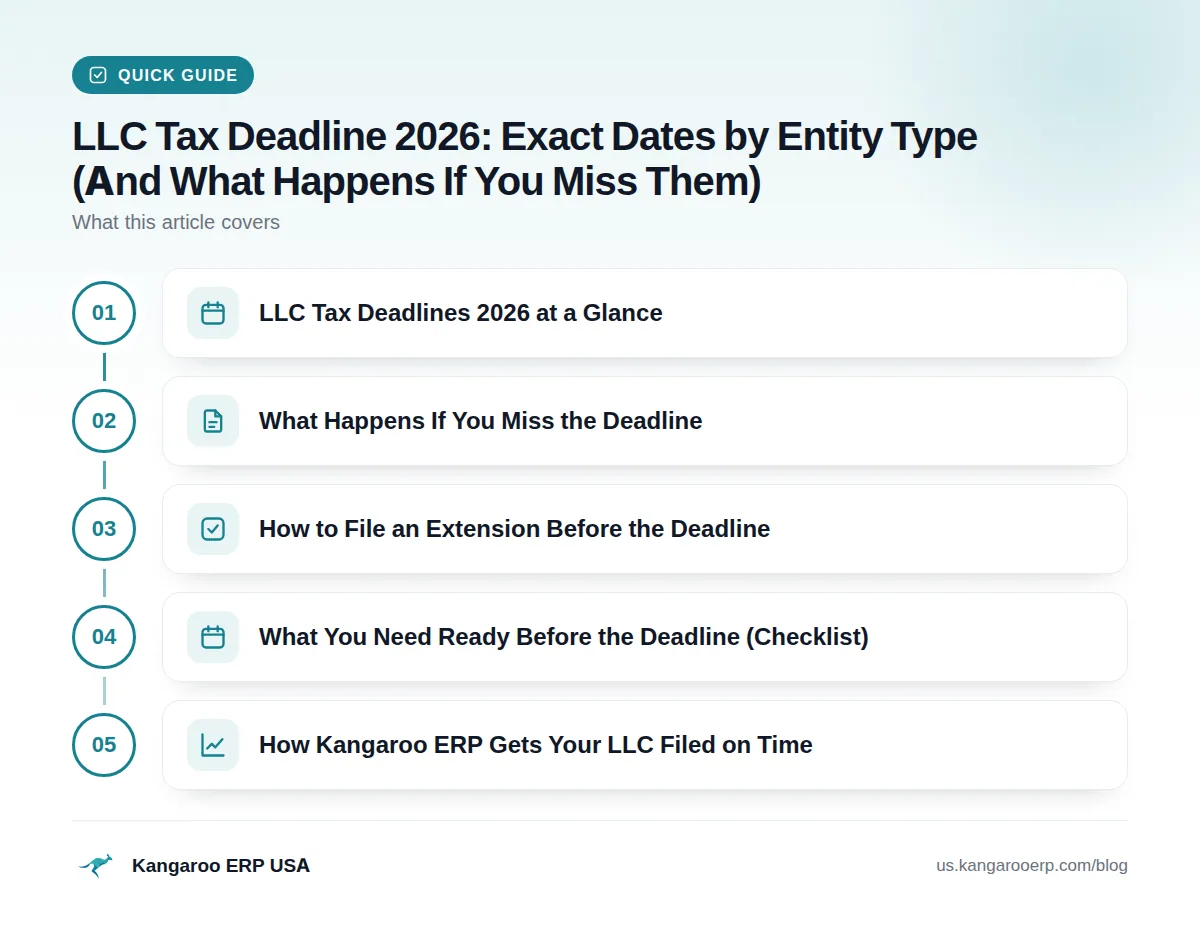
LLC Tax Deadlines 2026 at a Glance
Your deadline depends entirely on how the IRS classifies your LLC, not on the fact that it's an LLC. The IRS doesn't tax LLCs directly — it taxes them as a sole proprietorship, partnership, S-corp, or C-corp depending on the election you made (or didn't make) on Form 8832 or 2553. That classification is what determines your form and your date.
| Entity Type | Form | 2026 Deadline | Extended Deadline (if filed) |
|---|---|---|---|
| Single-Member LLC (default, disregarded entity) | Schedule C with Form 1040 | April 15, 2026 | October 15, 2026 (Form 4868) |
| Multi-Member LLC (default, partnership) | Form 1065 + Schedule K-1 | March 16, 2026 | September 15, 2026 (Form 7004) |
| LLC taxed as S-Corp | Form 1120-S + Schedule K-1 | March 16, 2026 | September 15, 2026 (Form 7004) |
| LLC taxed as C-Corp | Form 1120 | April 15, 2026 | October 15, 2026 (Form 7004) |
Single-Member LLC: April 15, 2026
If you never filed an election, your single-member LLC is a "disregarded entity." Your business income and expenses go on Schedule C, which is part of your personal Form 1040. The deadline is the same as every individual filer's: April 15, 2026.
Multi-Member LLC (Partnership, Form 1065): March 16, 2026
LLCs with two or more members default to partnership taxation unless they elected otherwise. Form 1065 is an information return — the partnership itself generally doesn't pay tax, but every partner needs their Schedule K-1 in hand to file their own return. That's why the deadline is a full month earlier than the individual deadline, per the IRS partnership filing rules.
LLC Taxed as S-Corp (Form 1120-S): March 16, 2026
If your LLC filed Form 2553 to be taxed as an S-corp, you file Form 1120-S on the same March 16 schedule as partnerships, also with K-1s due to each shareholder on that date.
LLC Taxed as C-Corp (Form 1120): April 15, 2026
LLCs that elected C-corp taxation file Form 1120 by April 15, 2026, for a calendar-year entity. If your LLC uses a fiscal year instead, the real rule is the 15th day of the fourth month after your tax year closes.
What Happens If You Miss the Deadline
The cost of missing the date depends on which form you're late with, and it starts compounding the day after the deadline — not a grace week, not "by the end of the month."
Late filing penalty per partner/shareholder per month
For Form 1065 and Form 1120-S, the IRS charges a flat per-partner, per-shareholder penalty for each month (or part of a month) the return is late, up to 12 months, under IRC §6698. For 2026, that penalty is $255 per partner or shareholder, per month. A three-partner LLC that files Form 1065 two months late owes 3 × 2 × $255 = $1,530 in filing penalties alone — before any tax or interest. This penalty applies even if the partnership had a loss or no income for the year.
Late payment penalty vs. late filing penalty
For returns where tax is actually owed (Schedule C via Form 1040, or Form 1120 for a C-corp), two separate penalties can apply:
- Failure-to-file: 5% of the unpaid tax per month or partial month, capped at 25%. If you're more than 60 days late, there's a minimum penalty of the lesser of $525 or 100% of the unpaid tax for 2026 returns.
- Failure-to-pay: 0.5% of the unpaid tax per month, also capped at 25%.
When both apply in the same month, the failure-to-file penalty is reduced by the failure-to-pay amount, so you effectively pay 5% per month combined for the first five months. After that, the filing penalty maxes out and only the 0.5% payment penalty keeps running.
How interest compounds daily
On top of penalties, the IRS charges interest on any unpaid balance, compounded daily under IRC §6622. For the fourth quarter of 2026, the underpayment rate is 7% annually. Interest keeps accruing even after you've paid the penalty in full, until the tax balance itself is paid off.
How to File an Extension Before the Deadline
An extension is free, automatic, and takes a few minutes — there's no reason to let a deadline pass without filing one if you're not ready.
Form 7004 for partnerships and corporations
Multi-member LLCs filing Form 1065, LLCs taxed as S-corps filing Form 1120-S, and LLCs taxed as C-corps filing Form 1120 all use Form 7004. Filed by the original deadline (March 16 or April 15, depending on your form), it grants an automatic six-month extension — moving 1065/1120-S filers to September 15, 2026, and 1120 filers to October 15, 2026.
Form 4868 for single-member LLCs
If your LLC is a disregarded entity reporting on Schedule C, you extend your personal return with Form 4868, pushing your filing deadline to October 15, 2026.
Extension gives more time to file, not to pay
This is the detail that trips people up every year: both Form 7004 and Form 4868 extend the paperwork deadline only. Any tax you expect to owe is still due on the original date — March 16 or April 15. File the extension but pay nothing, and you'll owe the failure-to-pay penalty and interest from the original due date forward, even though your return isn't technically late. For a closer look at tools built for exactly this timing problem, see our comparison of tax software for LLCs and S-corps.
What You Need Ready Before the Deadline (Checklist)
Whether you're filing on time or filing an extension with an accurate payment estimate, you need these numbers finalized — not estimated — before you touch a form.
Profit & loss and balance sheet
- Total revenue for the tax year, reconciled against bank deposits
- Every deductible expense categorized correctly (not dumped into "miscellaneous")
- Year-end balance sheet if your LLC is taxed as a partnership, S-corp, or C-corp
1099s and expense categorization
- 1099-NEC and 1099-K forms matched against your recorded income
- Contractor payments categorized correctly for your own 1099 reporting obligations
- Receipts attached to transactions, not sitting in a shoebox or inbox
K-1 allocations for each member
- Ownership percentages confirmed against your operating agreement
- Guaranteed payments to members separated from profit distributions
- Each member's share calculated before the return is filed, not after, since every member needs their K-1 to file their own personal return on time
How Kangaroo ERP Gets Your LLC Filed on Time
The deadline problem is rarely the calendar — it's that books aren't ready when the calendar demands them. Kangaroo ERP's bookkeeping and tax module is built to close that gap.
Auto-generated P&L and Schedule C/1065 data from your bookkeeping
Kangaroo ERP categorizes income and expenses as they happen and keeps a running profit & loss statement, so the numbers you need for Schedule C, Form 1065, or Form 1120-S are already organized instead of reconstructed in a panic the week of the deadline. That's also what powers the comparisons we cover in LLC tax prep software as a CPA alternative.
Deadline reminders tied to your actual entity type
Because your entity classification is set once in the platform, Kangaroo ERP's tax engine tracks the deadline that actually applies to you — March 16 for a partnership or S-corp election, April 15 for a disregarded entity or C-corp — instead of a generic "tax day" reminder that assumes everyone files the same form.
Don't let a deadline turn into a penalty
Kangaroo ERP turns your bookkeeping into organized, IRS-ready numbers for Schedule C, Form 1065, or Form 1120-S — before the deadline hits, not after.
File My LLC Taxes on Time →Frequently asked questions
When is the LLC tax deadline for 2026?
It depends on how your LLC is taxed. Single-member LLCs (Schedule C) and LLCs taxed as C-corps (Form 1120) file by April 15, 2026. Multi-member LLCs (Form 1065) and LLCs taxed as S-corps (Form 1120-S) file by March 16, 2026, since March 15 falls on a Sunday.
What is the penalty for filing LLC taxes late?
For Form 1065 or Form 1120-S, the penalty is $255 per partner or shareholder for each month the return is late, up to 12 months. For Schedule C or Form 1120 with tax owed, the failure-to-file penalty is 5% of unpaid tax per month (capped at 25%), plus a 0.5% per month failure-to-pay penalty, plus daily compounded interest at the current IRS underpayment rate.
Does an extension give me more time to pay?
No. Form 7004 and Form 4868 only extend the deadline to file the paperwork. Any tax you owe is still due on the original deadline — March 16 or April 15, 2026 — and unpaid balances start accruing interest and the failure-to-pay penalty from that date regardless of the extension.
What form do I need to file an LLC tax extension?
Multi-member LLCs filing Form 1065, LLCs taxed as S-corps filing Form 1120-S, and LLCs taxed as C-corps filing Form 1120 all use Form 7004 for an automatic six-month extension. Single-member LLCs reporting on Schedule C use Form 4868, the individual extension form, instead.
Sources
Informational content. It does not replace professional advice on your specific case.
Keep reading
 LLC & Self-Employment TaxesLLC Partnership Tax Software: What You Actually Need for Form 1065 and K-1s
Multi-member LLCs need software that files Form 1065 and issues a K-1 to each member. TurboTax Business, TaxAct and ProConnect all produce the forms — but none of them track partner contributions and distributions during the year, which is usually where the numbers on those forms start to go wrong.
Oct 14, 2026 · 6 min read LLC & Self-Employment TaxesLLC Tax Preparation Software: The Real Alternative to Hiring a CPA
LLC tax preparation software like TaxAct Business or H&R Block Premium & Business lets you file Form 1065 or Schedule C yourself for roughly $100-$250 a year instead of the $800-$2,500+ a CPA typically charges. You save money and get speed, but lose audit representation and year-round tax strategy — and the software still needs clean books to work.
Oct 10, 2026 · 7 min read LLC & Self-Employment TaxesSelf-Employment Tax vs. W-2 Calculator: What Workers and LLC Owners Both Pay
A 1099 self-employed worker pays the full 15.3% self-employment tax on net earnings, while a W-2 employee pays only 7.65%, with the employer matching the rest. For an LLC owner, hiring that same person as a W-2 employee adds payroll tax matching and unemployment insurance on top of the salary — costs a 1099 contract doesn't carry.
Oct 10, 2026 · 6 min read