
If you're asking whether you can file your LLC taxes completely apart from your personal return, the honest answer is: not unless you elect corporate taxation. By default, the IRS treats a single-member LLC as a "disregarded entity," meaning its income and expenses are reported on a Schedule C attached to your personal Form 1040. A multi-member LLC defaults to partnership taxation, filing its own informational return (Form 1065) but passing profits and losses through to each owner's personal return via a Schedule K-1. In neither default case does the LLC pay its own federal income tax or file "separately" in the way a traditional corporation does. The only way to get true separate filing is to elect C-corp status using IRS Form 8832, or S-corp status using Form 2553. This article breaks down exactly what changes with each option — and, just as importantly, what you should be doing with your books regardless of which box you check.
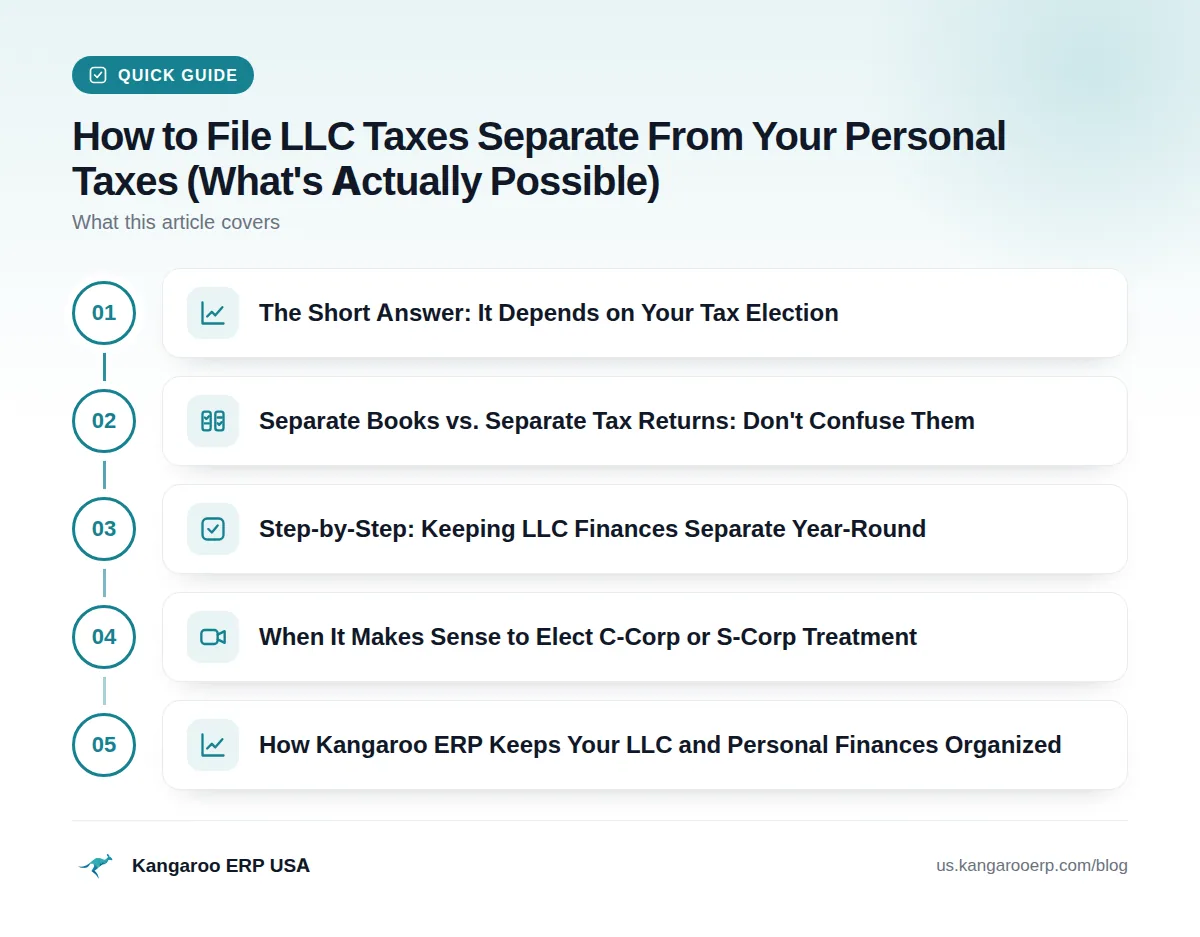
The Short Answer: It Depends on Your Tax Election
Default LLC taxation: profits flow to your personal return
Unless you file paperwork to change it, the IRS classifies your LLC based on how many members it has, not on the fact that it's an LLC at all. Per the IRS's own guidance on LLCs, a single-member LLC is automatically a disregarded entity — the owner reports business income and expenses directly on Schedule C of Form 1040, and net profit is subject to both income tax and self-employment tax. A multi-member LLC is automatically taxed as a partnership: the LLC files Form 1065 to report total income, but no tax is paid at the entity level. Each member receives a Schedule K-1 showing their share, which they report on their own Form 1040.
In both default scenarios, there is no separate LLC tax return that stands on its own the way a corporate return does. Your business results are mathematically part of your personal return, even though the LLC itself may have its own EIN, bank account, and bookkeeping.
Electing C-corp status: true separate filing (Form 8832)
If you want your LLC to file and pay its own corporate income tax — completely separate from your personal Form 1040 — you file Form 8832, Entity Classification Election. This election tells the IRS to tax your LLC as a C corporation. From that point forward, the LLC files Form 1120 and pays corporate tax on its profits; you're only taxed personally on salary or dividends the LLC actually pays you. This is the only scenario where "separate filing" is literally true at the federal level.
It's worth noting that Form 8832 does not create S-corp status — that requires a different form, Form 2553, which we cover further down. Filing Form 8832 when you actually wanted S-corp treatment results in C-corp taxation instead, which usually means paying tax at the corporate level and again on distributions — a costly mistake if you didn't mean to make it.
Separate Books vs. Separate Tax Returns: Don't Confuse Them
This is the distinction almost no one explains clearly, and it's the one that actually protects you. "Separate tax filing" is a choice the IRS lets you make (or not make). "Separate books" is not optional — it's something every LLC owner should be doing from day one, regardless of tax election.
Why commingling funds is the real risk, not the tax form
The liability protection an LLC offers — keeping your personal assets shielded if the business is sued or can't pay its debts — depends on courts being able to see the LLC as a genuinely separate entity. When owners pay personal bills from the business account, or deposit client payments into a personal checking account, courts can "pierce the corporate veil" and treat the owner and the LLC as the same thing. At that point, your personal house, car, or savings can be exposed, no matter what tax form you filed. The tax election you choose has nothing to do with this risk; sloppy bookkeeping does.
What a separate business bank account actually protects
A dedicated business bank account does two things, and neither of them changes your tax classification:
- It creates a paper trail that supports your LLC's legal separateness if liability is ever challenged.
- It makes your actual tax prep — Schedule C, Form 1065, or a corporate return — far faster and more accurate, because income and expenses are already isolated instead of mixed in with groceries and rent.
In other words: open the account and keep the books clean no matter which tax form you ultimately file. That decision is not conditional on your IRS election.
Step-by-Step: Keeping LLC Finances Separate Year-Round
Open a dedicated business account
This should happen before you take your first client payment. Use your LLC's EIN, not your Social Security number, to open the account, and route every business deposit and expense through it exclusively.
Track income and expenses by entity, not by owner
Whether you're a single-member LLC heading for Schedule C or a multi-member LLC heading for Form 1065, your books should categorize transactions by the business, not by whoever happened to swipe the card. This matters even more once you add a second member, a cofounder, or multiple ventures under one umbrella — mixing them makes it almost impossible to produce an accurate K-1 at year-end.
Run payroll or owner's draw correctly
How you pay yourself depends on your election:
| Tax status | How the owner gets paid | What it means for records |
|---|---|---|
| Default (disregarded entity / partnership) | Owner's draw — you transfer money to yourself, it's not a deductible wage | Draws must be tracked separately from business expenses; they don't reduce LLC profit |
| C-corp election (Form 8832) | W-2 salary, taxed at the corporate level before distribution | Requires actual payroll processing and payroll tax filings |
| S-corp election (Form 2553) | "Reasonable" W-2 salary plus distributions | Requires payroll plus careful documentation of what counts as salary vs. distribution |
Mixing these up — for example, taking an owner's draw while telling your accountant you're on payroll — is one of the most common sources of year-end tax confusion for new LLC owners.
When It Makes Sense to Elect C-Corp or S-Corp Treatment
Income thresholds where separation pays off
There's no official IRS dollar figure at which electing corporate taxation automatically makes sense — it depends on your net profit, what a "reasonable salary" looks like in your industry, and the added cost of running payroll. What's true in general is that the main financial reason owners elect S-corp treatment is to reduce self-employment tax on profits paid out as distributions rather than salary, while C-corp election is usually driven by other factors (raising outside investment, retaining earnings in the business, or planning for a future sale) rather than a pure tax-savings calculation. Because the math is specific to your numbers, this is a decision worth reviewing with a tax professional rather than following a generic rule of thumb.
Filing Form 8832 or Form 2553
The two forms are not interchangeable, and filing the wrong one changes your tax outcome:
- Form 8832 elects C-corp (or confirms partnership/disregarded) treatment. It can be made effective up to 75 days before the filing date and up to 12 months after it.
- Form 2553 elects S-corp status. For an LLC that hasn't previously filed Form 8832, the IRS allows Form 2553 alone to make the dual election into corporate classification plus S-corp status — you don't need to file both. The deadline is generally March 15 of the tax year you want the election to apply to, or within 75 days of forming the LLC or starting its tax year.
Missing these windows typically means waiting until the following tax year for the election to take effect, so timing matters if separate filing is part of your plan.
How Kangaroo ERP Keeps Your LLC and Personal Finances Organized
Separate ledgers, one dashboard
Whichever tax path you're on — Schedule C today, a possible S-corp election next year — your books need to stay clean the entire time. Kangaroo ERP keeps your LLC's income, expenses, and bank activity in dedicated ledgers from the moment you connect your business account, so personal and business transactions never get tangled together, regardless of which IRS form eventually applies to your profits. You can review our full breakdown of entity types and how they're taxed to see how this fits your specific LLC structure.
Auto-categorized expenses ready for whichever form you file
Because expenses are categorized as they come in, your records are ready whether your accountant ultimately prepares a Schedule C, a Form 1065 with K-1s, or a corporate return after a Form 8832 or Form 2553 election. That means less scrambling every tax season and fewer surprises about what is and isn't deductible. Explore how the Kangaroo ERP tax module organizes this year-round, and if you're comparing your options against hiring a CPA from scratch, our piece on LLC tax prep software as a CPA alternative walks through that trade-off in more detail.
Not sure if your LLC setup is actually protecting you?
See how Kangaroo ERP keeps your business and personal finances cleanly separated, no matter which tax election you choose.
Compare LLC Tax Setups →Frequently asked questions
Do I have to file my LLC taxes with my personal taxes?
By default, yes. A single-member LLC's profits are reported on Schedule C of your personal Form 1040, and a multi-member LLC passes profits to members' personal returns via Schedule K-1. The only way to avoid this is to elect C-corp taxation with Form 8832, which creates a fully separate corporate return (Form 1120).
How do I make my LLC taxes separate from my personal taxes?
File IRS Form 8832 to elect C-corp taxation, which makes the LLC file its own Form 1120 and pay its own corporate tax. If you want S-corp treatment instead, you file Form 2553, which handles the entity reclassification and the S-corp election together for most LLCs.
What is Form 8832 and when should I file it?
Form 8832, Entity Classification Election, is the IRS form used to choose how an LLC is taxed — most commonly to elect C-corp status instead of the default disregarded-entity or partnership treatment. It can be made effective up to 75 days before filing and up to 12 months after, per IRS instructions.
Does a separate business bank account change how my LLC is taxed?
No. A dedicated business account doesn't change your IRS tax classification — only Form 8832 or Form 2553 does that. What a separate account does is protect your liability shield and make accurate bookkeeping possible, which matters no matter which tax form you ultimately file.
Sources
Informational content. It does not replace professional advice on your specific case.
Keep reading
 LLC & Self-Employment TaxesLLC Partnership Tax Software: What You Actually Need for Form 1065 and K-1s
Multi-member LLCs need software that files Form 1065 and issues a K-1 to each member. TurboTax Business, TaxAct and ProConnect all produce the forms — but none of them track partner contributions and distributions during the year, which is usually where the numbers on those forms start to go wrong.
Oct 14, 2026 · 6 min read LLC & Self-Employment TaxesLLC Tax Deadline 2026: Exact Dates by Entity Type (And What Happens If You Miss Them)
Single-member LLCs and LLCs taxed as C-corps file by April 15, 2026. Multi-member LLCs (Form 1065) and LLCs taxed as S-corps file by March 16, 2026. Extensions (Form 7004 or 4868) add six months to file, but any tax owed is still due on the original date — late payment triggers interest and penalties immediately.
Oct 11, 2026 · 6 min read LLC & Self-Employment TaxesLLC Tax Preparation Software: The Real Alternative to Hiring a CPA
LLC tax preparation software like TaxAct Business or H&R Block Premium & Business lets you file Form 1065 or Schedule C yourself for roughly $100-$250 a year instead of the $800-$2,500+ a CPA typically charges. You save money and get speed, but lose audit representation and year-round tax strategy — and the software still needs clean books to work.
Oct 10, 2026 · 7 min read